semiAIfoundry

semiAIfoundry Research / Agentic intelligence

The Agentic Brain

Dual-Process Metacognition, Evidence-Gated Authority, and Runtime Governance

AI agents must decide how much to think, what to verify, and when they may act. This research connects those decisions through an agentic control plane, where evidence changes both understanding and authority.

Version 1.0.064-page preprintOpen access

The central coupling

The agent optimizes part of the process that governs its own authority.

A test can improve a decision. It can also authorize an action, or reveal a reason to deny it. An agent rewarded for completing a task therefore has incentives about which evidence to acquire, which checks to repeat, and which unfavorable findings to avoid.

This changes the engineering question. Fast inference, deeper reasoning, verification, and governance interact through one shared decision state. Their interaction determines how resources are spent, whether evidence is trustworthy, and which proposed effects are permitted to occur.

Evidence can improve the choice, unlock permission, or remove an action the agent wants to take.

The architecture

Two control questions. One coupled system.

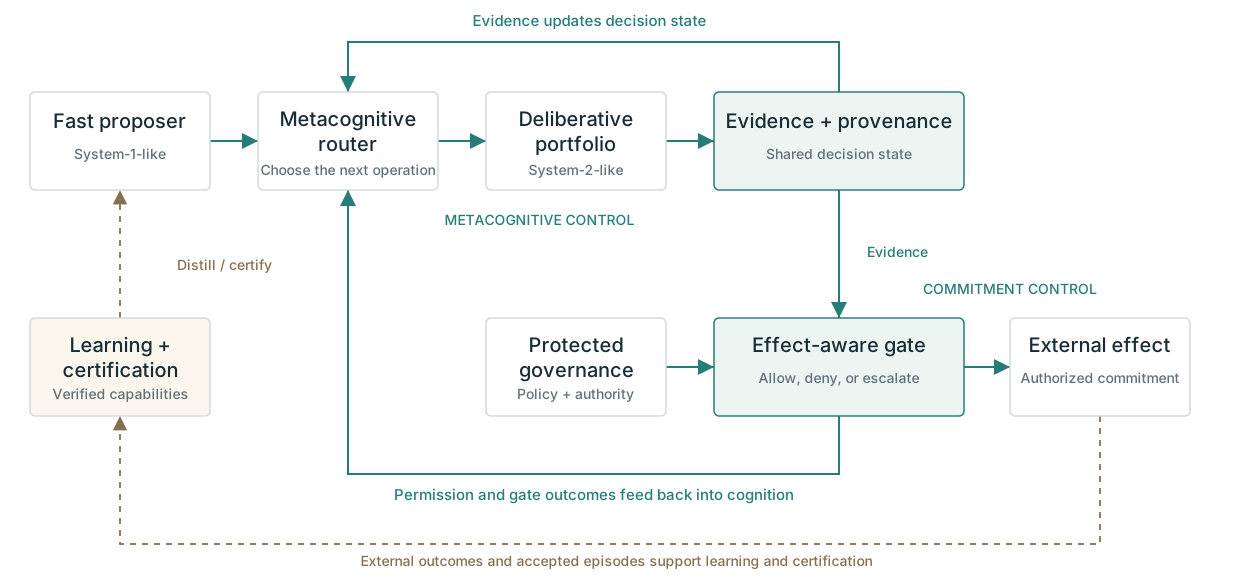
The metacognitive router asks whether the current proposal is sufficient and which computation or check is worth performing next. The commitment gate asks whether the resulting operation has the evidence and authority required for external effect.

Fast proposals enter a metacognitive router, which selects deliberation and verification. Evidence feeds the router and an effect-aware gate. Protected policy and authority govern the gate; permission and outcomes feed back. Accepted episodes can support learning and certification.
Adapted from Figure 1 of the paper. Evidence and gate outcomes feed back into cognition; learning and certification can move verified capabilities toward the fast path. Open diagram

Allocate cognition

Choose among reasoning, retrieval, execution, verification, specialist models, and human review under a real resource budget.

Preserve evidence

Retain provenance, dependencies, failed attempts, and current context as part of the decision state.

Control effects

Mediate operations by their data, destination, privilege, and reversibility, with governance state protected from the agent.

What the research contributes

An incentive-and-assurance framework for evidence-gated agency.

01 / Cognition and authority

Price what evidence changes.

A four-corner value-of-computation representation distinguishes changes in beliefs, changes in admissible actions, and their interaction. It makes the value of a check depend on the decisions and permissions that follow it.

Paper §§3–4

02 / Evidence incentives

Explain acquisition, avoidance, and gaming.

Complementary evidence chains can defeat short-horizon routing. Optional disqualifying checks can become privately costly. Controlled counterfactuals distinguish strategic ignorance from ordinary cost-sensitive skipping.

Paper §§4–5, 9.2, 9.4–9.5

03 / Adaptive assurance

Make evidence valid under selection.

Verifier bounds must cover the checks the agent is permitted to select. Statistical evidence then supports candidate-level admission control under adaptive testing and stopping, while a protected proposal budget controls risk across variants.

Paper §6

04 / Execution and learning

Bind permission to what actually runs.

Authorizations bind the payload, target, policy, dependencies, expiry, and evidence to single-use execution. Distillation can transfer competence into faster behavior; transferring authority requires admissible evidence or scoped certification covering routed use.

Paper §§3.5, 7, 9.3

Evidence and validation

Complete logging can still leave a verifier blind spot fully exploitable.

In the paper’s bounded adversarial challenge, retaining every result does not repair a misspecified evidence model. A gate using evidence valid for the selected subtype changes the result sharply.

Maximum unsafe admission on the declared blind subtype
Attempt-local evidence100%100%
Full history, pooled model100%100%
Selection-valid evidence5%5%
Selection-valid + required scan1.8%1.8%
Exact finite-model maxima, paper §9.3 / Figure 5. Same five-unit operation budget, at most one revision, and the separately stipulated fast route disabled. These are model results, rather than measured deployment rates.

A fully enumerated control environment

The paper crosses four gate regimes with two router objectives in a finite environment containing 558 states per cell. It compares exact planning, shorter-horizon planning, and 40 tabular Q-learning runs trained over eight million sampled episodes. Frozen policies are evaluated exactly.

Permission foresight changes the tradeoffs

In one aligned-objective comparison, forecasting future permission raises synthetic principal utility from 4.33 to 6.04 and reduces runtime cost, with a small increase in realized unsafe commitment. When objectives differ, better optimization can lower principal value. Four-operation lookahead reaches the initial-distribution optimum in both selection-valid cells.

Evidence reaches a checked executor

The reported validation includes 41 reference tests and 12 extension tests. Checks cover altered payloads, stale target and dependency versions, changed policies, expiry, forged receipts, replay, and concurrent reservations. The extensions compare two solvers at 35,712 state-value instances and replay 2,407 terminal intervention-policy paths through the reference gateway.

Calibration has a measurable price

Every possible count from fixed-sample verifier calibration is integrated over three registered unsafe subtypes. The study checks 5,793 confidence endpoints and shows how estimated bounds affect useful completion, resource use, and deferral relative to a known-kernel gate.

Research record

Read, inspect, and build on the work.

The Agentic Brain: Dual-Process Metacognition, Evidence-Gated Authority, and Runtime Governance

Accountable author
Fitih M. Cinnor for semiAIfoundry Research
Published
October 3, 2026 · Preprint v1.0.0 · 64 pages
DOI
10.5281/zenodo.23125976
License
Creative Commons Attribution 4.0

Cinnor, F. M. (2026). The Agentic Brain: Dual-Process Metacognition, Evidence-Gated Authority, and Runtime Governance (v1.0.0). Zenodo. https://doi.org/10.5281/zenodo.23125976

Contribution and accountability

Research across the intelligence continuum.

This work was produced through human-directed collaboration across human, artificial, and hybrid intelligence. AI systems materially contributed to conceptual exploration, formalization, literature analysis, adversarial critique, derivation checking, visualization, and manuscript development.

Fitih M. Cinnor initiated and led the research program and retains responsibility for the scientific claims, interpretation, release decisions, and corrections. The manuscript includes the detailed provenance statement.