

The Strength–Ductility Frontier: A New Design Rule for Strong, Ductile Metals
Design alloys that harden when it counts. Start with the yield strength and uniform stretch you want, then work backward to determine how much hardening the alloy needs and when it needs it.
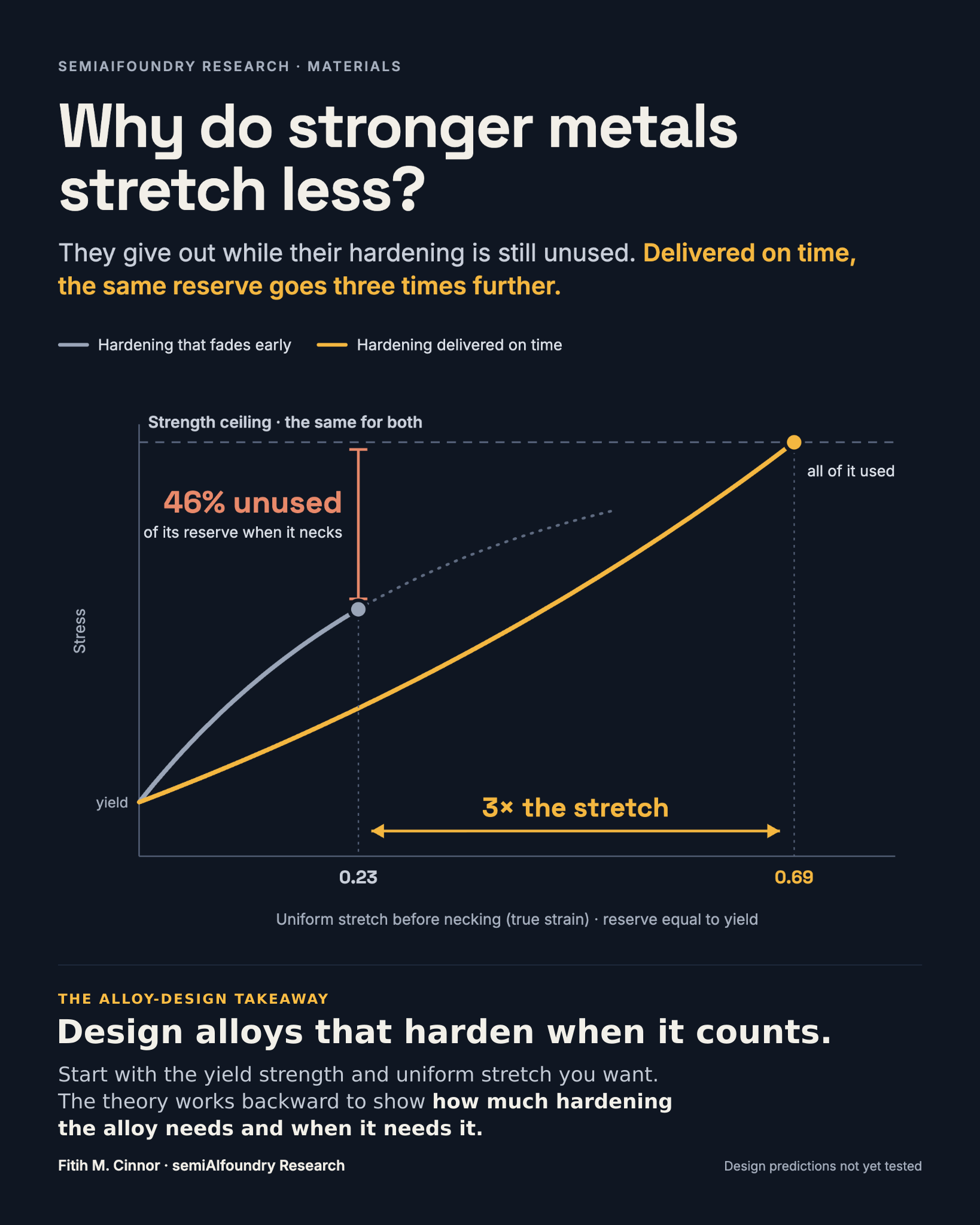
Design alloys that harden when it counts. Start with the yield strength and uniform stretch you want. The Strength–Ductility Frontier works backward to specify how much additional hardening the alloy needs and when it needs to deliver it. The paper proves sharp limits for three classes of hardening responses and identifies the schedules that reach or approach those limits.
Why a stronger pull can end uniform stretching sooner
As a specimen stretches, it gets thinner. The metal must harden fast enough to make up for the shrinking cross-section. If it falls behind, the load stops rising and deformation begins to concentrate in a narrow region called a neck. An alloy that hardens strongly at first can carry a higher peak force while reaching that peak sooner.
The classical Considère criterion tells us when a given tensile response reaches its load maximum. It does not tell us how far the best response in an entire class can go on the same reserve. That reserve is the alloy’s own capacity to develop additional flow stress as it deforms. A metal can begin to neck before it uses all of that capacity if it cannot harden fast enough at the strain where it needs to.
The breakthrough: a limit for a whole class of mechanisms
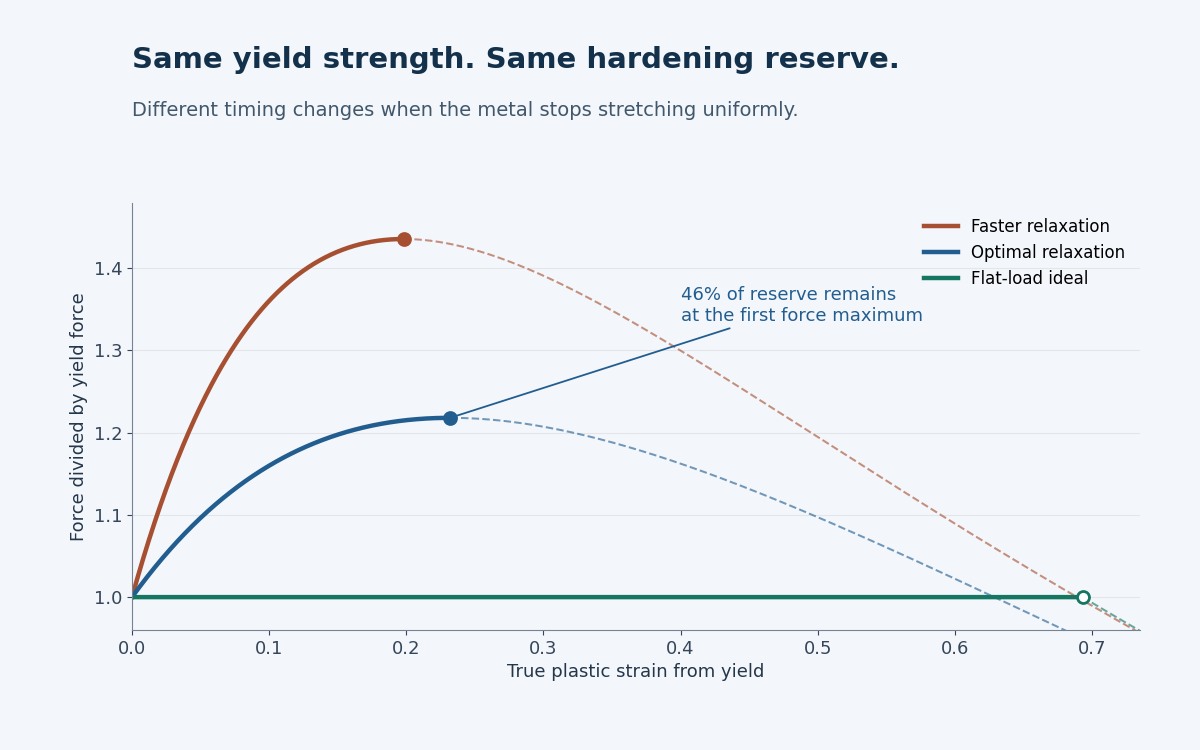
Rather than fitting one hardening curve and predicting where it peaks, we asked how far any curve in a class could go at fixed yield strength and reserve. The best exponential relaxation sets the lowest ceiling. The broader class whose hardening rate never rises has a higher ceiling. Ideal just-in-time hardening, which delivers just enough to hold the load flat, sets the upper bound.
The gaps between those limits are the design result. A target in the first gap rules out exponential relaxation but does not require the hardening rate to rise; a more persistent response can suffice. In the next gap, some mechanism must actually raise the rate. Above the ideal limit, rearranging the same reserve cannot work: the design needs more reserve, a different starting strength, or a different loading path.
Worked example. If the hardening reserve equals the yield stress, the respective model limits are 0.232, 0.500, and 0.693 true plastic strain. The best exponential response reaches its first force maximum with about 46% of its reserve unused. Those values depend on the starting strength and reserve; the ordering does not. The force–strain curves show this example.
Late hardening then becomes a question of delivery. The timing law gives the demand at the strain where the base material would otherwise become unstable. For mechanisms that can only supply hardening at finite rates, the paper gives a test for whether enough can be delivered over every remaining strain interval. Having enough in total is not the same as having it in time.
What a tensile test can tell us early
Three early stress readings bound when necking can begin for materials with a specified hardening shape. If the whole admissible interval clears the target, the readings can support a screening decision. If the interval straddles it, a later measurement or an independent constraint on hardening is worth more than trusting the early fit.
In the public TRR285 comparison, all 90 nominal lower bounds lay below the sampled force-peak proxy, across 22 test series. That ordering held for 68 specimens throughout a ±0.5 MPa stress range. The broader atlas surveyed 2,174 alloy-condition entries and scored 805 tensile records to flag candidates for direct measurement. In the two sheet alloys checked against full curves, using elongation at fracture as a proxy overstated inferred scheduling efficiency by 31%. That is precisely where a full tensile curve can change the design decision.
What this changes for alloy design
Consider a copper spring contact that must carry current and deform without necking. The design study sets three targets in the same processed state: 680 MPa proof strength, 12% uniform elongation, and 75% IACS conductivity. In a separate mechanics comparison at 680 MPa plastic onset and the same elongation target, the best exponentially relaxing response needs 258 MPa of reserve; the ideal timing needs 81.6 MPa. That shows why simply trying to add hardening can be costly when the same microstructure also has to conduct electricity.
The inverse calculation specifies the hardening that must still be available at the target strain. It shifts the next copper experiment from growing larger particles by default to testing whether dislocations bypass particles early enough and whether their hardening lasts. Measuring tensile properties and conductivity in the same material state would then tell us whether that route meets all three targets.
The same logic points to different measurements elsewhere. In a titanium laminate, the model predicts a sharp loss in uniform strain if a change in layer thickness moves mechanically effective transformation past the base instability. In a cryogenic steel vessel, the predicted grade order can reverse even when phase-marker strains do not change. A coupon can tell us when a phase appears; the vessel calculation tells us why we must also measure how much hardening it contributes along the vessel’s loading path.
Start with what the part needs. Use the theory to set the hardening capacity and timing, select mechanisms that can deliver both, and measure the properties that distinguish the most promising candidates.
Read and build on the research
The full manuscript contains the proofs, tensile-data comparisons, worked application studies, and research provenance. Fitih M. Cinnor led the work and takes responsibility for its scientific claims, interpretation, and corrections.
Fitih M. Cinnor (2026), The Strength–Ductility Frontier: Just-in-Time Hardening, the Limits of Uniform Deformation, and a Design Rule for Strong, Ductile Alloys. Semi AI Foundry, LLC. Read the canonical manuscript on Zenodo.