

EVECM: A research milestone for solid-state battery reliability
A completed 101-page compendium connects lithium transport, fracture, defect populations and measurement to reliability-aware engineering, with twelve scientific and engineering invention families.
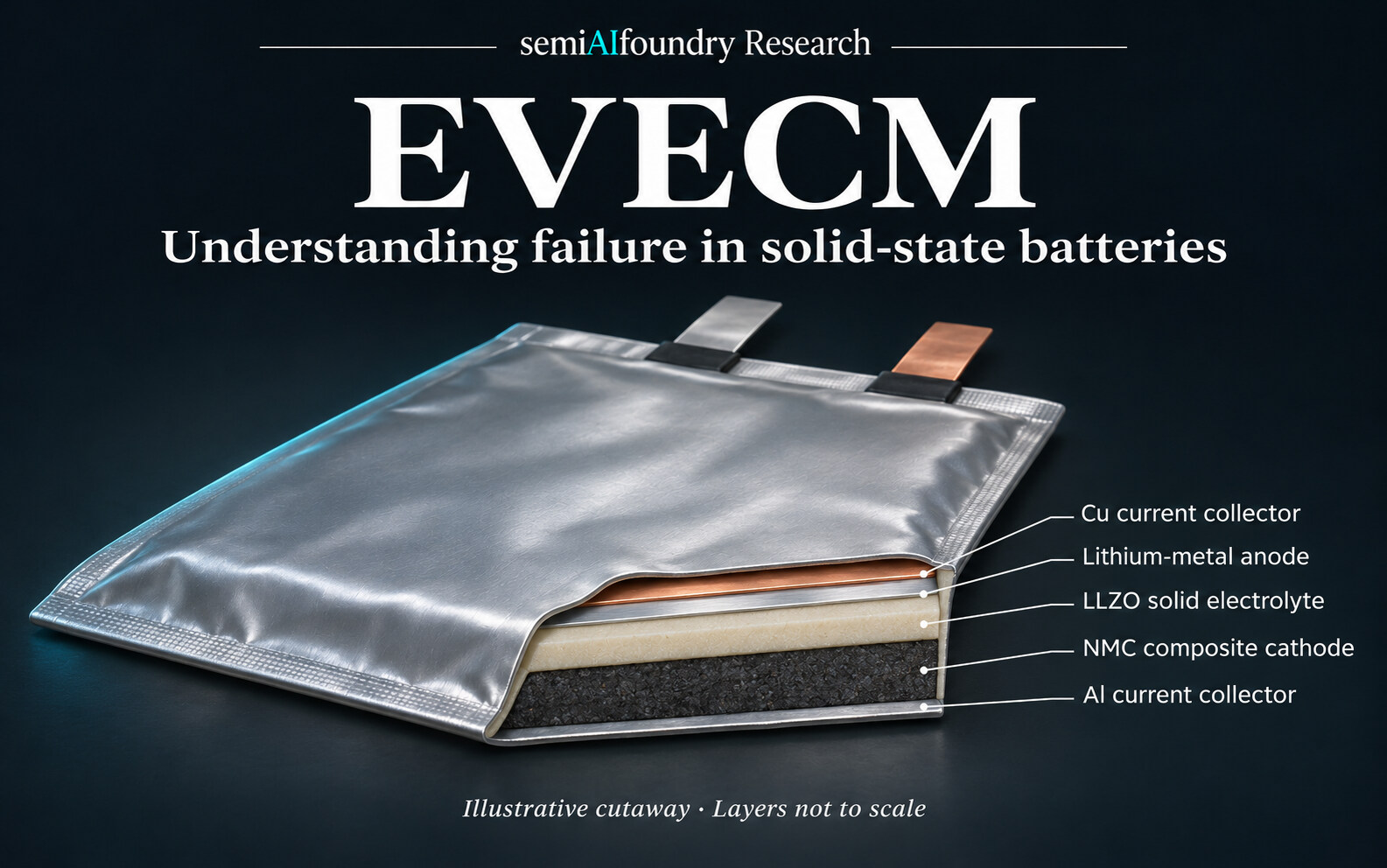
Lithium-ion batteries power phones, laptops, electric vehicles and grid-scale energy storage. Solid-state lithium batteries offer a path to longer driving range, lighter devices, faster charging and longer service life. High-performance laboratory cells already demonstrate the technology’s promise; the next challenge is to deliver those advantages reliably and affordably at scale.
The energy-density opportunity is substantial. A Nature Energy review describes a projected lithium-metal solid-state cell at 393 Wh/kg, compared with 265 Wh/kg for a conventional lithium-ion cell using the same cathode chemistry. A later techno-economic analysis identifies potential beyond 500 Wh/kg. These are cell-design projections: the benefit to a complete battery pack depends on its materials, packaging and supporting systems.
Academic experiments also show that rapid charging and long life can coexist. Ye and colleagues reported 80% capacity retention after 6,000 cycles in a laboratory solid-state pouch cell charged and discharged at 5C, a nominal 12-minute rate. The test used 55 °C and 25 MPa of applied pressure. This is a significant demonstration of fast, durable cycling under controlled conditions; translating it into large cells operating under everyday conditions remains an engineering task.
Replacing flammable liquid electrolytes with suitable solid materials also opens a route to safer batteries. The benefit must be established for the complete cell: published safety analysis shows that internal short circuits and heat-generating reactions remain hazards. Solid electrolytes therefore create opportunities for safer design without removing the need for thermal management and abuse testing.
The main hurdles are manufacturing and durability. Thin electrolyte layers must be produced consistently, while solid-on-solid contacts must carry ions efficiently through repeated expansion and contraction. Contact loss, interfacial resistance and mechanical cracking can erode performance. As Janek and Zeier explain, scalable processing, practical operating pressure and cost are inseparable from electrochemical progress. Broad adoption depends on solving these problems together, with different materials and applications advancing at different rates.
This is where interface reliability becomes decisive. Uneven lithium growth can enter small defects and interact with cracks; a conductive path through the solid electrolyte can cause an internal short circuit. EVECM connects these physical processes to measurements, reliability predictions and engineering decisions. Its aim is to help turn promising materials and laboratory performance into better manufacturing checks, more durable architectures and operating strategies that preserve useful battery life.
Introducing the EVECM milestone
semiAIfoundry Research has completed a major research milestone with Extreme-Value Electro-Chemo-Mechanics (EVECM): an integrated scientific and engineering framework for lithium solid-electrolyte interfaces. The completed compendium connects lithium transport, fracture, active-defect populations, physical observation and intervention through one evolving material state.
The central idea is that the same physical account should explain what happens inside a material, the probability of a specific failure event, what an instrument measures, and which interventions can preserve useful service. Energy and lithium-inventory balances connect those predictions and constrain how they can be interpreted.
The work brings together analytical results, reproducible reference calculations, comparisons with published observations, and twelve scientific and engineering invention families. It establishes a foundation for experimental research into solid-state battery reliability, manufacturing, materials design and useful lifetime.
Read the open preprint on Zenodo.
Why this milestone matters
Lithium penetration into a ceramic solid electrolyte is simultaneously a transport, mechanics and reliability problem. First crack extension, filament propagation, separator traversal and a terminal short circuit are different events. The likelihood of each depends on manufactured defects, which defects become active, retained lithium, and the duration and sequence of loading.
A single critical-current value cannot capture all of those dependencies. EVECM links the local physical mechanisms to populations of defects and then to explicit measurements and engineering decisions. This creates a common basis for comparing materials, architectures and operating histories at matched capacity, power, risk and service requirements.
For useful lifetime, the question becomes concrete: which physical states must be preserved or restored, what service can still be delivered, and what does an intervention cost in time, energy and collateral damage?
What the research contributes
- Reliability across protocols and scale. A transport-resolved initiation model connects active-defect populations, electrode area and loading history to event-specific reliability. Finite dwell can select an interior most-dangerous flaw size within the model’s admissible range, changing which part of a manufactured defect distribution matters most.
- A clearer account of evolving fracture risk. Reciprocal transformation mechanics links crack opening, chemical work, stored energy and local crack-driving intensity. The analysis identifies conditions under which intensity can grow while pressure relaxes, and how retained transformation fields can alter stability without changing intrinsic fracture toughness.
- Independent tests of diagnostic interpretation. Electrical, isotope and optical observation models provide conservation witnesses, conductance certificates and capacity bounds. These tests require instrument responses and failure predictions to be consistent with the same physical state, rather than accepting separate fits as evidence of a shared mechanism.
- Quantitative constraints on battery architecture. Fracture-compatible inventory and throughput bounds clarify storage–transport tradeoffs. Accommodation concepts specify rate, capacity and conductance conditions for directing lithium away from dangerous internal deposits.
- Detection connected to qualified action. An integrated engineering architecture connects multimodal diagnosis, production qualification, sequential testing, formation, recovery and control. A proposed action must have one continuation policy that can actually be implemented from available observations across the models consistent with those observations.
- A reproducible route from physics to decisions. Exact counterexamples expose failures of separately safe hidden-state choices, one-step diagnostic scores and horizon-independent decision summaries. A normalized population-to-action calculation demonstrates the complete model-to-decision chain under declared service and risk constraints.
From detection to mitigation
The engineering contribution is organized around a practical chain: register → diagnose → infer → qualify → act → verify. Geometry, operating history and the endpoint are registered first. Measurements update an estimate of the physical state. Candidate actions are then tested against risk and service requirements, and an independent measurement checks whether the intended state transition actually occurred.
The compendium integrates twelve scientific and engineering invention families, with detailed embodiments and validation targets. Their scope spans diagnostic instruments and multimodal sensing, calibration articles, active-population prediction, manufacturing qualification, lithium accommodation, formation, recovery, residual-stress-engineered separators, conditional filament interruption, and validity-aware control and assurance software.
These connections matter because reducing a fitted risk estimate is not the same as restoring a material. Rest or current interruption does not automatically remove retained lithium or eliminate crack driving. A recovery intervention must demonstrably change the relevant physical state, and irreversible damage must remain in the record.
Potential mitigation routes therefore have explicit conditions and tradeoffs. Accommodation needs both sufficient uptake rate and available headroom. Residual compression must be evaluated alongside interior tension, conductivity and aging. Conditional filament interruption needs its own thermal, mechanical and reconnection assessment and cannot substitute for independent protection.
Relevance for research, manufacturing and design
- Materials and interface research: distinguish changes in elastic driving, chemical transformation, transport and intrinsic fracture resistance through jointly testable predictions.
- Manufacturing and scale-up: connect measured defect populations and loading protocols to area, current, dwell and inspection requirements, rather than relying on a universal maximum-flaw cutoff.
- Diagnostics and operation: select measurements that resolve decision-relevant states, account for the physical effects of testing, and qualify actions using the information a controller actually has.
- Battery lifetime and architecture: compare designs and interventions by the useful service they can support under explicit reliability and resource constraints.
The framework also supplies constructions that may transfer to other systems involving pressurized inclusions, retained transformation fields and incomplete observations, including hydraulic fracture, hydrogen embrittlement and stress-corrosion cracking. Each application requires its own state variables, boundary conditions and measurement models.
A collective research contribution
The work was developed through human-directed human–AI collaboration at semiAIfoundry Research. Fitih M. Cinnor is the Research Lead and Accountable Author. Cinnor established the objectives and research directions, challenged formulations, interpreted significance, directed technical review and determined the standards of evidence.
AI collaborators made substantive contributions to scientific synthesis, mathematical exploration and derivation, theorem and counterexample development, software implementation, numerical verification, figure generation, scientific writing and critical technical review. These contributions are recognized separately from human authorship and accountability, consistent with our Research in the Open commitment.
Public research record
Extreme-Value Electro-Chemo-Mechanics of Lithium Solid-Electrolyte Interfaces is available as an open preprint on Zenodo, version v1. The record contains the complete 101-page scientific and engineering compendium and is released under the Creative Commons Attribution 4.0 International license.
For research, validation or collaboration inquiries, contact semiAIfoundry.